


Creating a standout nicotine pouch brand requires more than compelling can design. The success of your product is determined by what’s inside—a precise formulation that dictates flavour, nicotine release, cost, and market appeal. For brands navigating this competitive landscape, understanding the core nicotine pouch ingredients is the critical first step. Yet, technical terms like ‘fillers’ or ‘pH regulators’ often create confusion, impacting both final product quality and regulatory compliance.
This manufacturer’s guide is engineered to demystify the entire formulation process. We will break down each essential component, from the nicotine base and plant-based fillers to the sweeteners and stabilisers that define a premium user experience. You will gain the technical knowledge to confidently select ingredients for your target audience, understand their functional roles, and collaborate with a manufacturing partner to develop a unique, high-quality product that captures the market.
The Core Anatomy: Deconstructing a Modern Nicotine Pouch
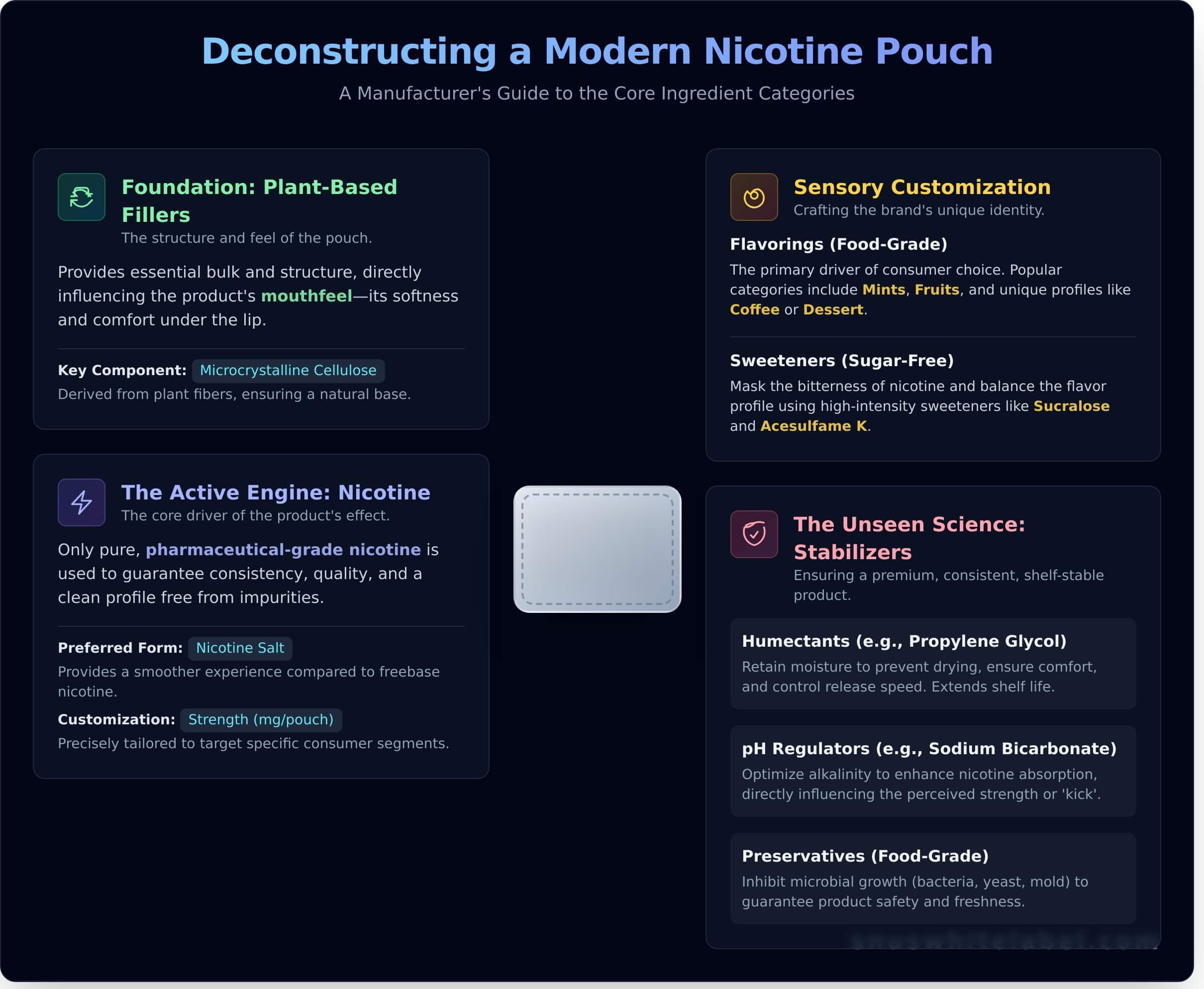
A modern nicotine pouch is more than a product; it is a precisely engineered delivery system. The success of your brand hinges on a formula where every component serves a distinct purpose, from initial flavor impact to the overall user experience. Understanding the core nicotine pouch ingredients is the first step toward creating a market-leading product that stands out for its quality and consistency.
The typical nicotine pouch composition is built from five fundamental categories, each playing a critical role in the final formulation:
- Fillers (plant-based)
- Nicotine (pharmaceutical-grade)
- Flavorings (food-grade)
- Sweeteners (approved)
- Stabilizers and pH regulators
Foundation: Plant-Based Fillers and Pouch Material
The foundation of any pouch is its filler, typically microcrystalline cellulose derived from plant fibers. This ingredient provides essential bulk and structure, directly influencing the product’s mouthfeel—its softness and comfort under the lip. The pouch itself, constructed from a non-woven, food-grade material, acts as a gatekeeper, ensuring a consistent and controlled release of both nicotine and flavor for a predictable user experience.
The Active Engine: Pharmaceutical-Grade Nicotine
Nicotine is the key active ingredient and the primary driver of the product’s effect. We utilize only pure, pharmaceutical-grade nicotine to guarantee consistency, quality, and a clean profile free from impurities. Nicotine salt is often the preferred form, as it provides a smoother experience compared to freebase nicotine. The strength, measured in milligrams (mg) per pouch, is a critical point of customization, allowing your brand to target specific consumer segments with precision.
Customization Deep Dive: Crafting Your Brand’s Unique Experience
While core components provide the foundation, the customization of sensory elements is what defines a brand and secures market share. The precise combination of flavor, sweetness, and mouthfeel creates a unique user experience that builds brand loyalty. This is where a product moves from a simple nicotine delivery system to a distinct consumer good. All adjustable components, including flavorings and sweeteners, are food-grade, ensuring a safe and premium product.
Flavorings: The Heart of Your Brand’s Identity
Flavor is the primary driver of consumer choice. We utilize a vast library of natural and artificial food-grade flavorings to develop your brand’s signature profile. Whether you aim to capture the market with a classic mint or differentiate with a unique blend, the key is consistency and longevity. A successful flavor profile delivers a satisfying taste from the first moment to the last, ensuring a reliable experience in every pouch. Popular categories include:
- Mints: Spearmint, wintergreen, and peppermint dominate the market.
- Fruits: Citrus, berry, and tropical blends appeal to a broader audience.
- Unique Flavors: Dessert, coffee, and beverage-inspired options for market differentiation.
Sweeteners: Balancing and Enhancing the Flavor
Modern nicotine pouches are sugar-free to ensure stability and avoid oral health concerns. Instead, we use high-intensity, non-sugar sweeteners like sucralose and acesulfame potassium (Ace-K). These ingredients are critical for masking the natural bitterness of nicotine and rounding out the flavor profile. The level of sweetness is a key customizable attribute, allowing you to tailor the product to specific consumer preferences, a detail explored in this scientific review of nicotine pouch formulation. This control over the balance of your nicotine pouch ingredients is essential for a premium product.
Humectants: Ensuring Optimal Moisture and Comfort
Humectants, such as food-grade propylene glycol, are essential for product quality and user experience. Their primary function is to retain moisture, preventing the pouch from drying out and becoming harsh. The correct moisture level dictates the mouthfeel, comfort, and speed of nicotine and flavor release. Properly balanced humectants also extend the product’s shelf life, guaranteeing that every can meets your brand’s high standards from production to the final consumer.
The Unseen Science: Stabilizers for a Premium, Shelf-Stable Product
Beyond the core components that define flavor and strength, a successful nicotine pouch formulation relies on functional stabilizers. These unseen ingredients are not fillers; they are critical for quality control, safety, and consistency. They ensure that the product your customer opens is identical in quality to the one that left our facility. Incorporating these elements demonstrates a commitment to manufacturing excellence, utilizing components that are standard across the food and pharmaceutical industries to deliver a reliable, shelf-stable product.
pH Regulators: The Key to Nicotine Effectiveness
The perceived strength or ‘kick’ of a nicotine pouch is directly influenced by its pH level. We use food-grade pH regulators, such as sodium bicarbonate, to optimize the alkalinity of the pouch environment. This adjustment is crucial for converting nicotine into its ‘freebase’ form, which allows for more efficient absorption through the oral mucosa. The strategic use of these regulators is a fundamental aspect of formulation, as confirmed by a comprehensive scientific review of ingredients, and it is key to delivering the consistent user experience your brand requires.
Preservatives: Guaranteeing Freshness and Longevity
Because nicotine pouches contain moisture, they require protection against microbial growth. Preservatives are essential for inhibiting the development of bacteria, yeast, and mold, guaranteeing product safety throughout its lifecycle. By using approved, food-grade preservatives, we extend the product’s shelf life and ensure its integrity. This focus on preservation minimizes spoilage, protects your investment, and provides consumers with a fresh, reliable product every time.
Ultimately, the meticulous selection of these stabilizing nicotine pouch ingredients is what separates a premium product from an inconsistent one. This scientific approach to formulation guarantees safety, stability, and performance. At Snus Whitelabel, we manage these technical details so you can focus on building your brand with confidence. Our expertise is your quality guarantee.
Strategic Formulation: How Ingredients Impact Your Business Success
Choosing your nicotine pouch ingredients is more than a technical task—it is a core business strategy. The right formulation directly impacts your unit cost, target market appeal, and regulatory standing. It is the foundation upon which a successful brand is built. Viewing your formulation as a strategic asset allows you to control profitability and secure a distinct position in a competitive market.
Ingredient Choices and Unit Cost
Every component in your pouch influences your final unit price. Balancing premium quality with competitive pricing is essential for market viability. Key cost drivers include:
- Ingredient Grade: Pharmaceutical-grade fillers and flavorings command a higher price than standard options but can be a key differentiator for a premium brand.
- Nicotine Source: Synthetic nicotine often offers more stable pricing, while tobacco-derived nicotine costs can fluctuate with agricultural markets.
- Flavor Complexity: Developing a unique, multi-layered custom flavor profile involves R&D costs not associated with our extensive library of market-proven flavors.
Understanding these variables is the first step toward building a profitable product line. Get a detailed quote based on your desired formulation.
Formulating for Your Target Audience
Your product’s formulation is your most direct line of communication with your ideal customer. Different consumer profiles expect different experiences, and your ingredient choices must reflect that.
- New Users: Attract this segment with lower nicotine strengths (4-8 mg), accessible fruit or citrus flavors, and a softer, more comfortable pouch material.
- Experienced Users: Cater to seasoned consumers with higher strengths (12-20 mg), intense mint or wintergreen flavors, and a formulation that provides a faster, more pronounced nicotine release.
Elements like moisture level, pH balance, and pouch texture also define the user experience, distinguishing a standard product from a premium one.
Navigating Regulatory Compliance (TPD & FDA)
Market access depends entirely on compliance. Regions like the EU (under the Tobacco Products Directive) and the US (under FDA authority) have stringent regulations governing acceptable ingredients, nicotine levels, and required documentation. Selecting compliant nicotine pouch ingredients is non-negotiable.
An experienced B2B manufacturing partner stays current on these evolving legal landscapes. We ensure that every ingredient is fully documented and permissible in your target market, removing regulatory hurdles and streamlining your path to launch. We manage the complexity of compliance so you can focus on building your brand.
Strategic Formulation: Your Path to Market Success
Understanding the anatomy of a nicotine pouch is only the beginning. As we’ve explored, every component—from the base fillers and nicotine source to the flavor systems and stabilizers—plays a crucial role in defining your product’s performance, shelf life, and market appeal. Strategic selection of nicotine pouch ingredients is not merely a technical task; it is the foundation of your brand’s success and your primary tool for differentiating yourself in a competitive landscape.
Now, it’s time to transform your vision into a premium, market-ready product. Leverage our expertise to navigate the complexities of formulation. With access to over 7,800+ flavor profiles, full customization of nicotine strength, and expert guidance on regulatory-compliant ingredients, we provide the streamlined partnership you need to succeed. Ready to formulate your winning product? Contact our experts for a quote.
Your Brand. Our Expertise. Let’s build your success together.
Frequently Asked Questions
What is the difference between synthetic nicotine and tobacco-derived nicotine?
Tobacco-derived nicotine is extracted directly from the tobacco plant. Synthetic nicotine is created in a laboratory environment, completely independent of tobacco. The primary advantage of synthetic nicotine is its purity; it is free from tobacco-specific impurities, which results in a neutral taste. This allows for cleaner, more precise flavor profiles in the final product, as there are no underlying tobacco notes to mask during formulation.
What ingredients are never used in high-quality, tobacco-free nicotine pouches?
Premium, tobacco-free nicotine pouches explicitly exclude any tobacco plant matter, including leaves, dust, or stems. Furthermore, high-quality formulations avoid the use of non-food-grade additives, prohibited substances, and unstable chemical compounds. Our manufacturing process adheres to strict quality control standards, ensuring every component is approved, pure, and safe to deliver a consistent and reliable product for your brand.
How does the choice of filler material affect the pouch’s feel and release?
The filler material is critical for the consumer experience. Microcrystalline cellulose, a refined plant fiber, provides a soft, comfortable mouthfeel and supports a steady, controlled release of nicotine and flavor. Other plant-based fibers can be used to achieve different textures or release characteristics. The selection of the right filler is a key step in defining the pouch’s softness, moisture level, and overall performance in line with your brand’s goals.
Can I create a completely proprietary flavor for my nicotine pouch brand?
Yes. Full flavor customization is a central part of our B2B manufacturing service. While we maintain an extensive library of market-proven flavors, our expert flavorists can collaborate with your team to develop a unique and proprietary flavor profile. This R&D process ensures your product has a signature taste that distinguishes it from competitors, giving your brand a significant market advantage.
How do the ingredients in a nicotine pouch affect its shelf life?
Shelf life is directly determined by the stability of the nicotine pouch ingredients. pH stabilizers are essential for maintaining nicotine potency and preventing degradation over time. Humectants, such as propylene glycol, ensure the pouch retains its optimal moisture level and does not dry out. Using high-quality, stable flavorings and fillers further contributes to a longer, more consistent product life, guaranteeing quality from production to the end consumer.
Are all flavorings and sweeteners used in nicotine pouches safe?
We exclusively use food-grade flavorings and high-intensity sweeteners that are approved for oral consumption and comply with stringent safety regulations. Common sweeteners include sucralose and acesulfame potassium, both known for their stability and established safety profiles. All components are sourced from vetted suppliers to ensure every ingredient in your final product is verified as safe for its intended use.
What role does pH level play in the effectiveness of a nicotine pouch?
The pH level is a critical formulation parameter that governs nicotine absorption. A higher, more alkaline pH (typically between 8 and 9) converts nicotine into its “freebase” form, which is more readily absorbed through the oral mucosa. This results in a faster onset and a more noticeable effect for the user. We use pH adjusters to precisely control this level, ensuring your product delivers a consistent and effective experience.


